Importer stock: why is an employee still doing this?
17 oktober 2026, PaulImporter stock. When I first heard the term, I had to ask what it was. “What kind of stock, and what is the importer or dealer supposed to do with it?” I have been writing about dealer processes for more than ten years. I did not know the importer stock process. And yet there are dealers who spend hours on it every week. If even someone who talks to dealers every day does not see it, who is actually taking a critical look at it?
What is it?
Since the beginning of this year, alongside regular company stock, there has been importer stock. We used to call it floating stock. It concerns cars that are already at the dealership but are still registered in the importer’s stock. The difference lies in liability. Whoever has the car in their stock is responsible. If a car is in the importer stock and the dealer sends it out on the road without it being registered to an owner, then it is not the dealer who is liable, but the importer. So it makes sense that no importer wants to run that risk. The solution is simple: the car is transferred to the dealer’s stock. Neatly arranged. Except someone has to actually do it.
This is how it works now
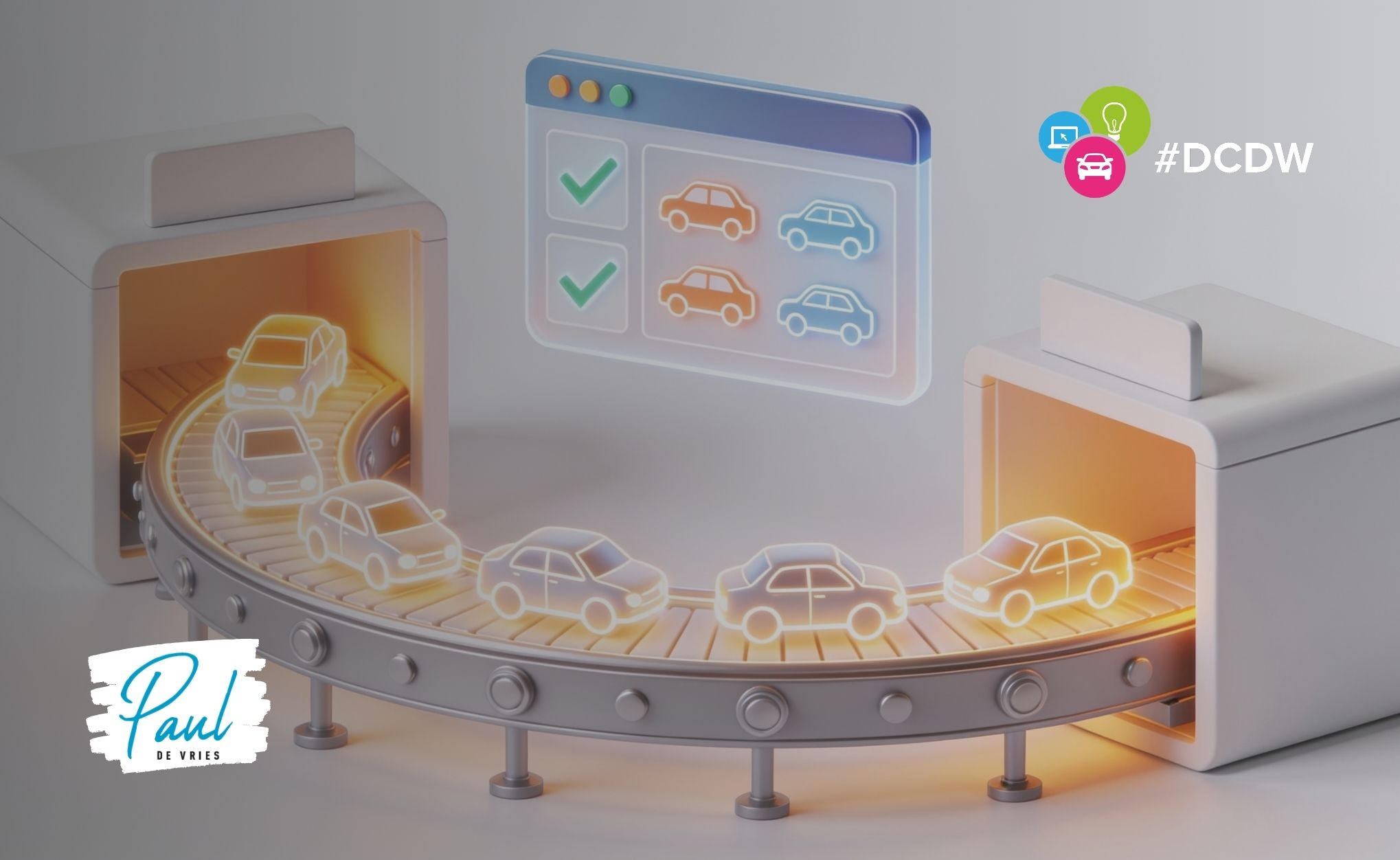
For Volvo, Kia and Renault, this runs through the Kirpestein portal. An employee retrieves the details of the released vehicle there. He then processes the car with the RDW (the Dutch vehicle authority). And he then puts the record of that action back into Kirpestein. Is that complicated? No. Someone who does it every day gets it done in no time. Ask dealers, and one will say it takes about five minutes per car. Another, with some routine, does it in one to two minutes. You could argue about that for a long time. I am not going to. Because whether it is one minute or five, the question remains the same.
Do the maths
Take a dealer holding that processes 5,000 cars a year this way. This is a worked example, not an existing client. At one minute per car, that is over 83 hours a year. At two minutes, about 167 hours. And at five minutes, you reach more than 400 hours. That is more than ten full working weeks. At an internal hourly rate of €55, this process costs around €4,600 a year in the fastest case and almost €23,000 in the slowest. For work where it is known in advance exactly what needs to happen. That range is wide. The conclusion is not.
A human as the integration
What strikes me most is not the amount. It is what that employee is actually doing. He takes information from one system, performs an action in a second system and puts the result back into the first. He is the integration. A human API, if you look at it technically. That sounds disrespectful. It is not meant that way. Good people are scarce, especially at dealerships. You need them for customer contact, for sales, for the exceptions where experience and common sense make the difference.
And that is my point. For years I have been saying that dealers follow up leads too late and too little. Call first, then email, within five minutes. The answer I hear most often? “We do not have the people for that.” Meanwhile, those same people are copying information from screen to screen. I overlooked it too. Until this month, I did not even know this process existed.
The real risk is not in the minutes
A manual task does not just cost time when you carry it out. Above all, it costs money when you forget it once. If a car has not been transferred properly, you often do not notice straight away. The problem only surfaces when the car has to be registered to the customer. At that point it is no longer an internal administrative error. By then there is a customer at the counter who has come to collect his new car.
There is a second side to this. As long as the car is in the importer stock, liability lies with the importer. A forgotten transfer is therefore not just your problem. It is also your importer’s problem. So automation here is not just about hours. It is about how many checklists, handover moments and checks you want in a process.
We organise the manual work very well
What stands out is that dealers usually have processes like this well under control. Someone is responsible. There is a work instruction. At holdings with multiple sites, it has been agreed who processes which cars. Sometimes there is even an extra check, so nothing gets left behind. All perfectly logical, as long as it is manual work. But at some point you have to ask a different question. Should we organise the manual work better? Or can we remove the manual work altogether?
The latter is what GRIPnGO does with Importeursvoorraad & Go. The process itself stays the same. The data still comes from Kirpestein, the processing still runs through the RDW and the record still goes back to the portal. Only now a system performs those steps, not an employee. The dealer can still see which cars have been processed and so keeps the overview.

Is it really that easy?
No. And I say that deliberately. At larger holdings, the difficulty is not in the technology, but in the question of which site a car should be processed under. That is not always obvious. If you do not work that out properly, you are just stringing a few actions together and moving the problem elsewhere.
Nor do I think everything should be automated just because it can be. There are plenty of processes where you actually want someone to look and decide. And a bad process does not become a good one because you put software in the middle of it.
On top of that, software costs money. Volumes, wage costs and working methods differ from dealer to dealer. A small dealer with a few hundred cars a year will arrive at a very different sum than a holding with 5,000.
But with importer stock, almost everything is predictable. The information is digital, the processing is digital and the result is stored digitally. That leaves one question, even for the dealer who does it lightning fast. If a system can do this by itself, why is a person still doing it every day?
Where those hours should go
Digitalisation in automotive does not always have to be about AI, data platforms or new business models. There is still a lot to gain in small, boring processes that nobody notices. Precisely because they are small.
My opinion? A dealer who says he has no time to call leads within five minutes, but does spend hours a year transferring cars between two systems, does not have a staffing problem. He has a priorities problem.
So do this tomorrow. Look up how many cars you processed via the importer stock last year. Ask the employee who does the processing how many minutes it really takes. Multiply. And then decide whether you still want to pay for that work, or whether you would rather spend those hours on the phone.
Tijmen van Dobbenburgh will be giving a presentation on this story at the upcoming #DCDW. You can register at www.dcdwevents.nl