


The engaged shopper on the car portal!
3 september 2026, PaulIn the many discussions and conversations I have with my colleagues at Marktplaats, with dealers, with salespeople and with the fellow competitors at the other portals, the added value of the portals often comes up. What is the value, exactly? Is it just online and telephone leads? Or is it the result of a VDP view, with which everything begins?
If you have bad photos and bad descriptions and don’t apply a market-conforming price, then you won’t get any leads as a result either. The more I talk about these kinds of things, the more convinced I become that the added value of a portal lies in the ‘eyeballs’, and therefore the VDP views, and that all the other things are a bonus.
The starting point of the Customer Journey
Portals are, par excellence, the starting point of the Customer Journey. You have a choice of more than 200,000 cars and, with the search filters — yes, those are already more than 20 years old… — many customers filter out their ideal car. From the SRP (Search Result Page), people go to the VDP (Vehicle Detail Page), and there they spend a lot of time. The more time, the greater the engagement.
Making the car a favorite? An engaged metric: the customer is more interested than usual. Making a printout? Likewise. This way, on the VDP you have a number of things that tell you the customer is more than averagely interested. And yes, the lead, by phone or by email, is the ultimate proof, but not the only one.
The URL referral
I want to get to the click-through! On some portals, the option to click through (so the click to your own website) is absent, or only visible on the VDP after extra payment via a package. At Marktplaats, you can always click through, and recently I was able and allowed to take a look at a large dealer group to see how this click, this referral, behaves on the dealer website.
After all, my friend Brian Pasch always says that this is the most engaged shopper you could wish for on your own website, but is this supported by data from GA4? Whereas Marktplaats would prefer to have VDP views on its own platform, the click-through (URL) goes to the dealer website. In terms of visitor numbers, Marktplaats is then not the largest. That’s often a Google CPC campaign or Gaspedaal, but let’s take a look at the quality of the visit.
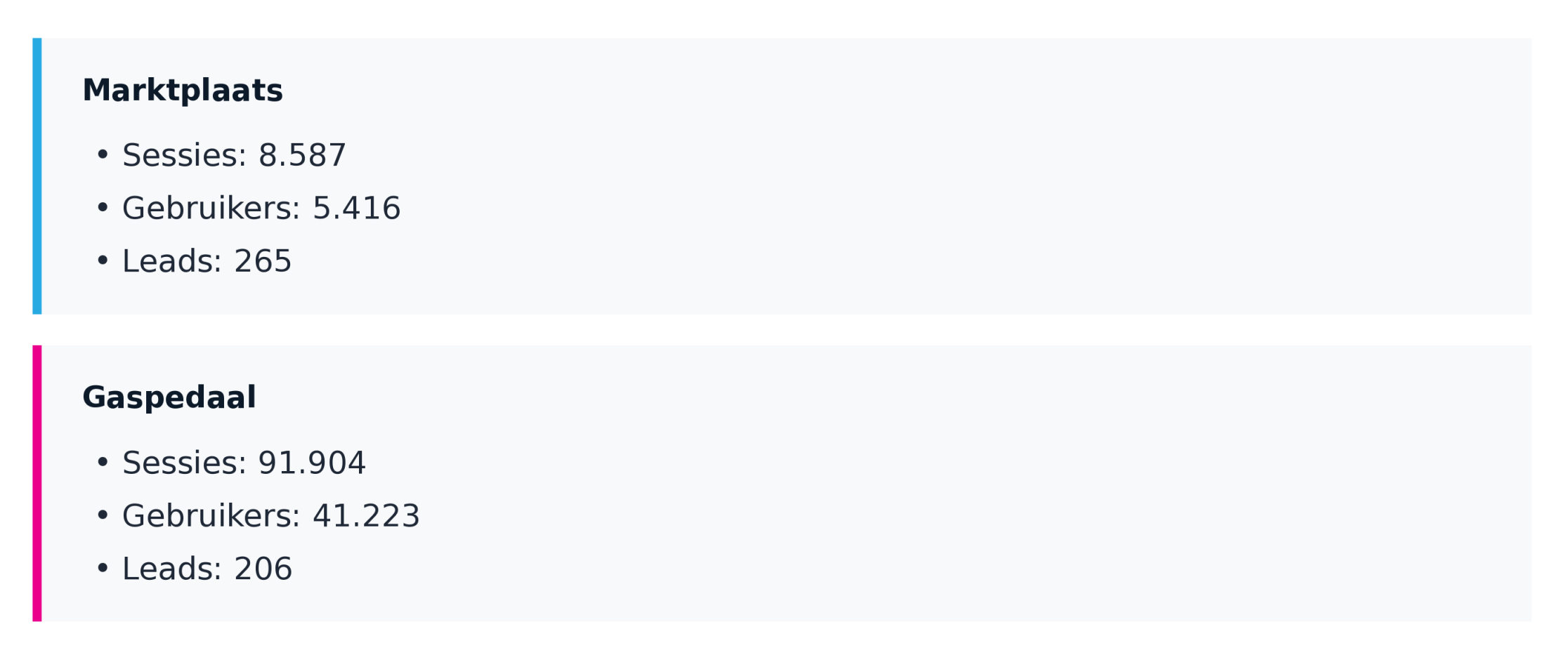
Marktplaats delivers a fraction of the visits but the most leads.
You can see that the Gaspedaal visitor is there in large numbers, but is less deeply interested than the Marktplaats visitor on the dealer website. The Gaspedaal searcher sees Gaspedaal as the source and hops from one car back to Gaspedaal and on to another, until the choice has been made. You also see this reflected in the number of sessions per user: 2.23 for Gaspedaal against 1.59 for Marktplaats. More visits, but no deeper interest — rather the opposite. If you look at the CPC model that Gaspedaal applies, this can be an excellent choice for this dealer.
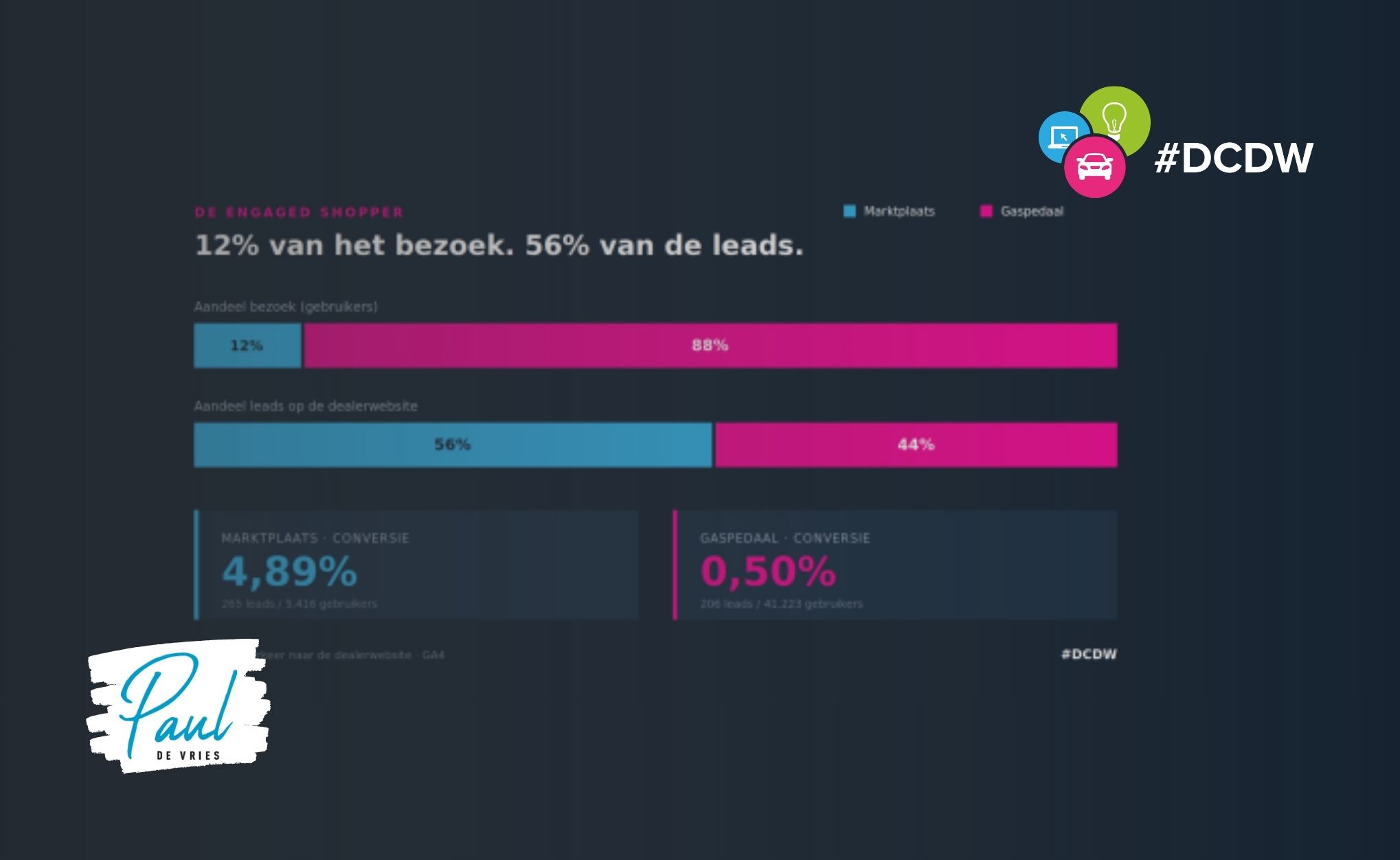
12% of visits. 56% of leads in a 1-on-1 comparison with Gaspedaal.
Deeper visit
With the Marktplaats visitor, you see very clearly that they have already made their choice to a much greater extent. 4.89% of the visitors convert to a lead on the dealer website. At Gaspedaal that’s 0.50%, almost ten times as low. Put differently: Marktplaats accounts for 12% of the visits and for 56% of the leads.
In addition, this dealer has hundreds more leads via Marktplaats itself in that period, alongside the more than 100,000 VDP views. Just a word about those percentages: how GA4 calculates and how I calculate. This is important, because if you open this report yourself and see different numbers, I want you to know why.
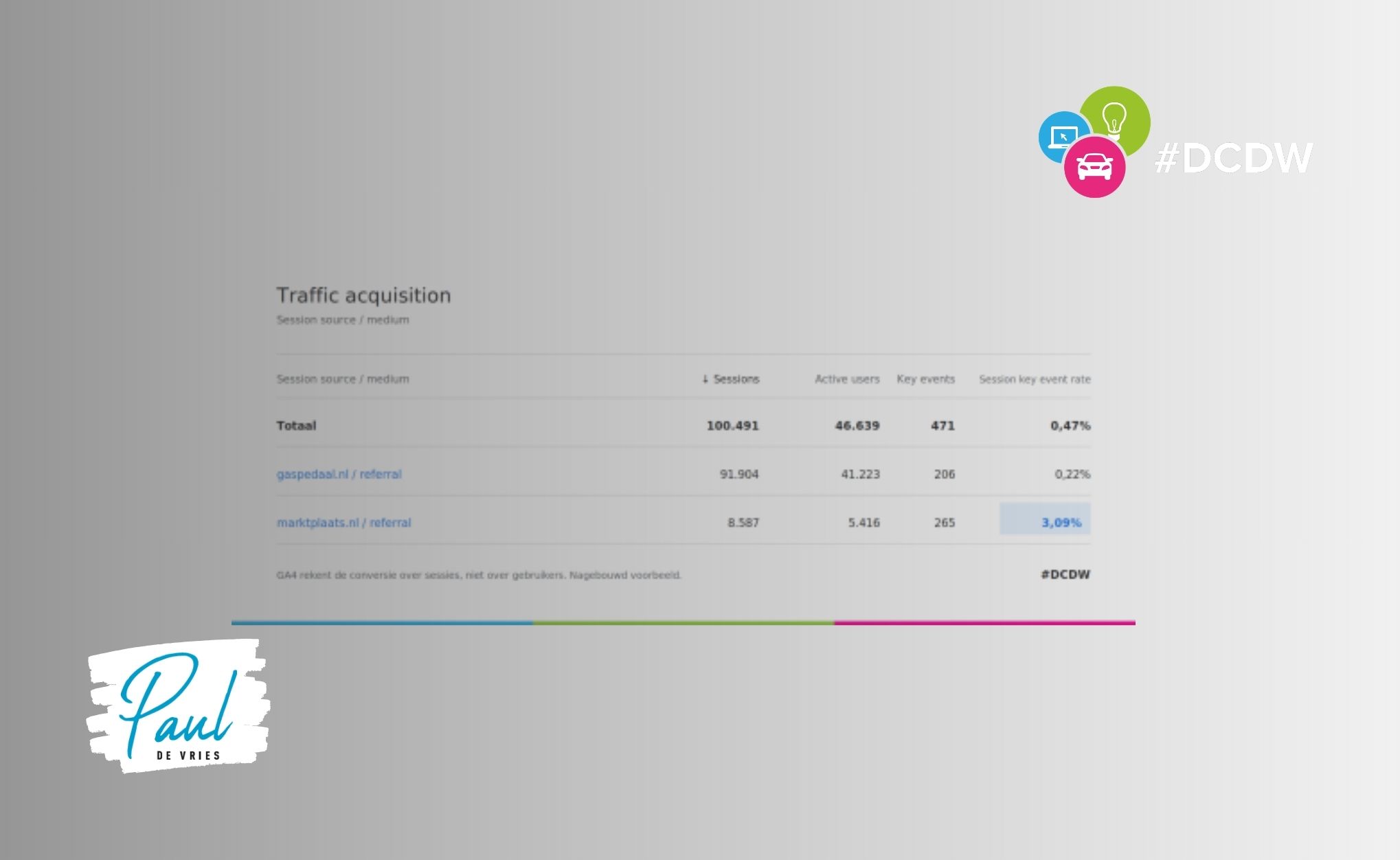
This is how it looks in GA4: Reports → Acquisition → Traffic acquisition, dimension Session source / medium.
GA4 has its own metric for this: Session key event rate. It divides the number of key events by the number of sessions. In this example, that yields 3.09% for Marktplaats and 0.22% for Gaspedaal. A difference of a factor of 14. I myself calculate with leads divided by users: 4.89% against 0.50%. A difference of a factor of 10.
Both are correct. The difference lies in the denominator. And that’s not a detail, because that’s exactly where the behavior lies that this whole article is about.
2.23 versus 1.59
The Gaspedaal visitor comes back on average 2.23 times in a session, the Marktplaats visitor 1.59 times. That’s precisely that hopping back and forth between portal and dealer website. If you calculate with sessions, then that behavior is penalized: every extra hop lowers the conversion.
If you calculate with users, then you count one searcher one time, however often they come back. In this article, I deliberately use the user variant, because you want to count a buyer and not a click. It’s also the most conservative of the two: it makes the difference between the two portals smaller, not larger. So whoever prefers to stick to the GA4 standard arrives at an even sharper contrast.
What you especially must not do is mix the two up. If you compare your portals with one another, then choose one denominator and stick to it — in every report, every month, for every source.
However you calculate
However you calculate, both ways are good. Both can have an excellent ROI on what they’re meant to do — and they’re also two different models: Gaspedaal charges per click, Marktplaats works with a subscription. You only make that comparison truly fair on cost per lead. But apart from that, you simply see that a portal, and let’s take Marktplaats as an example, does more than just leads in an online form or via a phone call. It’s also the VDP views and the URL click-throughs that prove these are really the engaged shoppers.
If you base the ROI only on the conversion of leads to sales, then you’re dependent on your lead process. And about that I could actually write a few more books. What you want is a real, fair comparison of what a portal such as Marktplaats, AutoScout, AutoTrack and ViaBOVAG does for you. In that comparison, the URL click is not a lead, but it is the best and most high-quality engaged shopper that lives in your Google Analytics 4.