


The dynamic VDP page — where is it?
2 juli 2026, PaulWho’s up? The website builders, the portals or the vehicle management systems?
A dynamic VDP page, or Vehicle Detail Page (in Dutch the product page), is the page on which your car is displayed and where all the information about the vehicle can be found. On portals such as Marktplaats, this is perhaps the most important page of all. After all, when a consumer searches, they eventually end up on the search results page, where everyone wants to be in position one. If the potential customer then clicks on your car, they land on the VDP page.
On this VDP page, the consumer can scroll through the photos and view all the information relating to options, technical specifications, SH certificates, NAP data, certifications and other relevant vehicle information. These days there’s so much data available that a VDP page can sometimes be overwhelming, while for many people only a few things are really important.
What’s important?
That’s different for everyone. A buyer of an older car, for example, considers the replacement of the timing belt and the date on which this was done very important, as well as the MOT. A buyer of a used EV, on the other hand, considers the State of Health (SoH) of the battery important. Yet another attaches great value to infotainment features, such as Apple CarPlay.
So what’s important to me is of no value whatsoever to someone else.
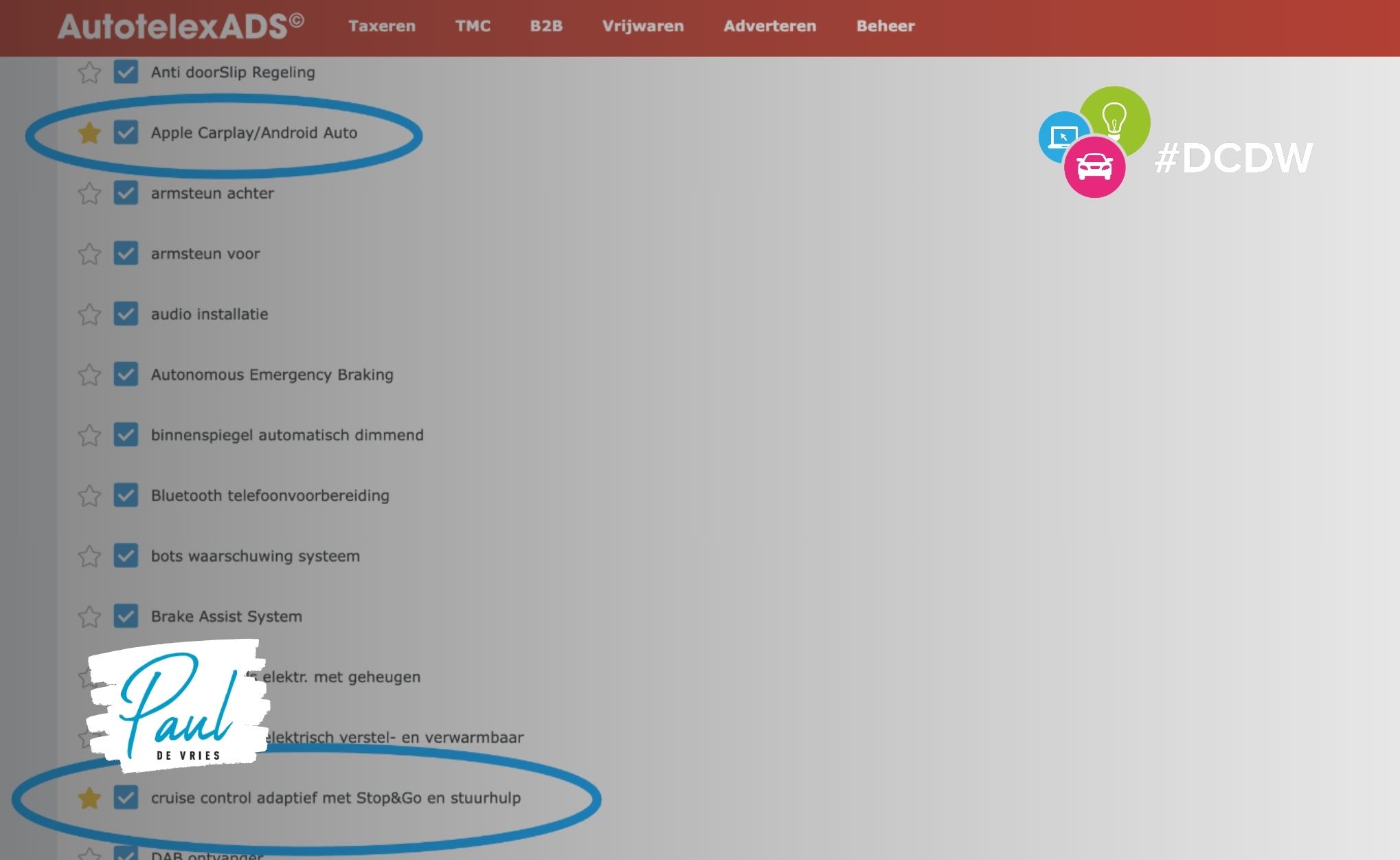
You see this reflected in Marktplaats’s data as well. Besides make, model and type: what else do potential buyers consider important? The most searched-for item, for example, is Apple CarPlay. The VMSs, such as Autotelex, have already taken steps in this regard, for example with the ‘distinguishing option’ function. This places more emphasis on specific features of the car on the VMS’s own VDP page.
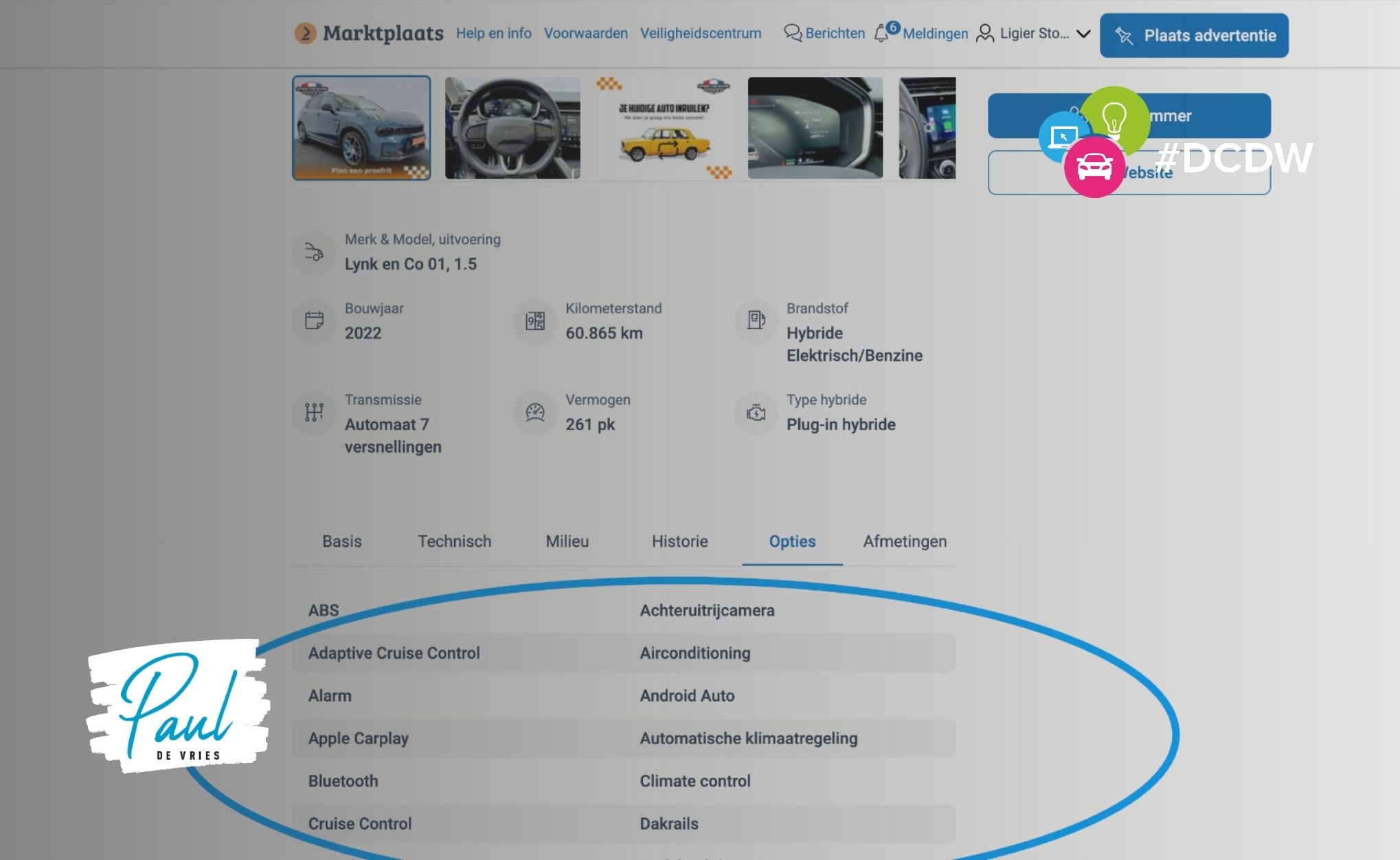
On Marktplaats, however, the options are still simply displayed in alphabetical order. So nothing is done with my favorite or highlighted options. On AutoScout24 it’s exactly the same. There you even have to expand the options first, after which they’re then presented — just as on Marktplaats — in a rather uninspiring way.
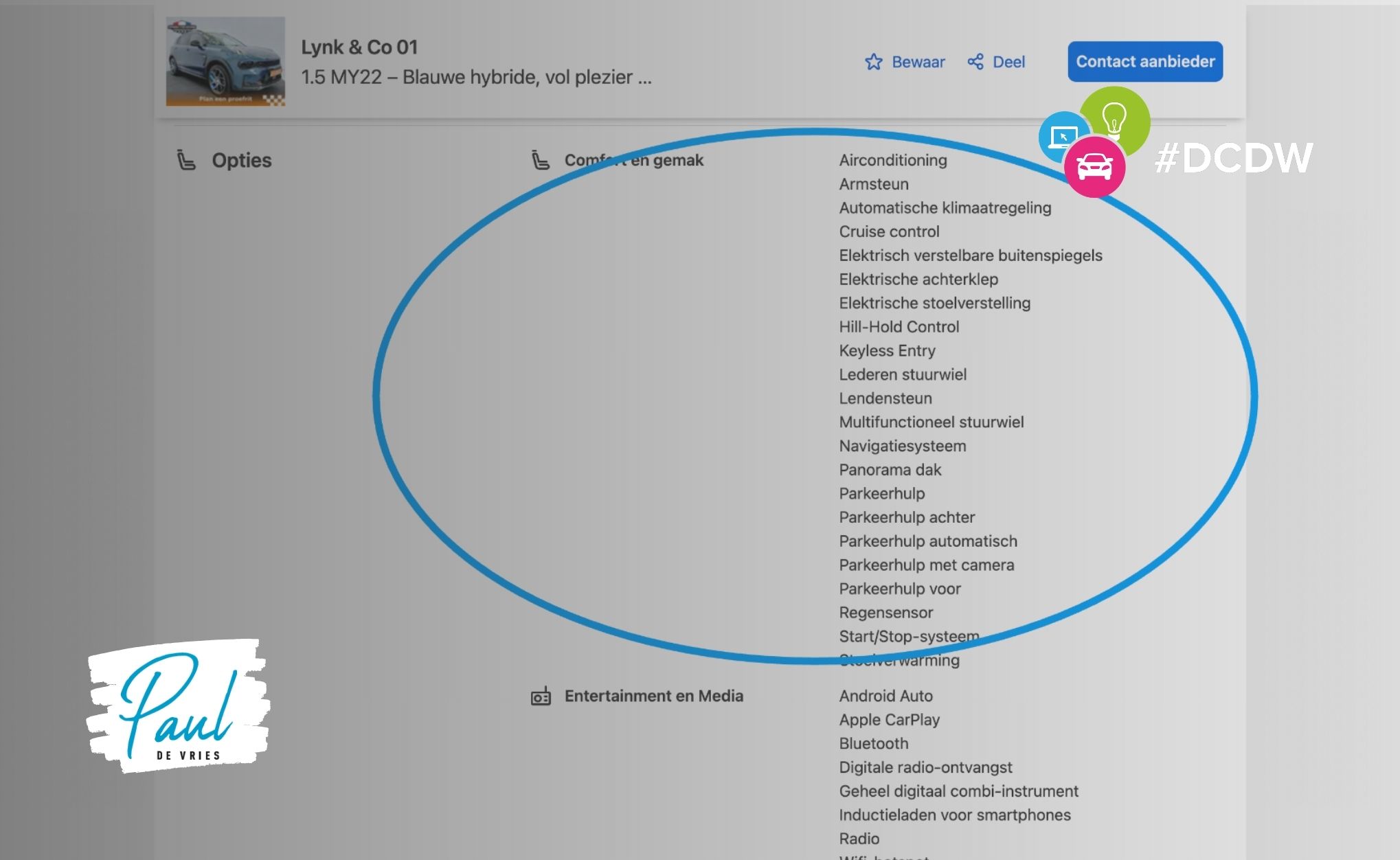
So portals still hardly do anything with this, and website builders usually only do so when their client, the car business, explicitly asks for it.
The dynamic VDP
In the conversations I recently had with Erik van den Heuvel of Hexon, we arrived at the dynamic VDP. I’ve been having these kinds of discussions with Erik for years. More than ten years ago, we already came up with the idea of the “highlighted option” together, back then still at WheelerDelta. So the subject has kept us busy for years now.
But by now we’re a step further….
The technology already exists
What many people don’t know is that the technology for a dynamic VDP is actually already available today. Erik showed me how Hexon’s ILSA platform handles this.
Instead of simply listing all vehicle data in a fixed order one below the other, the system first determines what is most relevant to the visitor at that moment. In doing so, it looks not only at the vehicle itself, but also at the context.
Is it an electric car? Then things like battery capacity, range and charging specifications take priority.
Is it a motorcycle? Then the engine displacement is what’s important.
Does a car business have exclusively new cars on its website? Then there’s little point in prominently stating that the vehicle is new.
In addition, the system also looks at the search query with which the visitor arrives on the VDP. If someone searches specifically for a tow bar, then the maximum towing weight can appear right at the top. In Germany, legal obligations are even taken into account, so that consumption and emission figures automatically become visible when that’s necessary.
On the basis of all this information, ILSA determines which six characteristics are shown right at the top of the page. Not because the system chooses at random, but because it’s precisely that information that has the most value for the visitor at that moment.
As Erik van den Heuvel of Hexon describes it:
“A modern Vehicle Detail Page must automatically adapt to both the vehicle and the visitor. That’s why ILSA dynamically determines which characteristics are most relevant, on the basis of the vehicle, the user’s search query, the website’s settings and local legislation. That way, every visitor immediately sees the information that is most important to him or her.”
Below that, all vehicle characteristics are then displayed after all. Not statically, but likewise built up dynamically, in the right language, with the right formatting and logically distributed across the various sections of the page.
Perhaps even more interesting is that Hexon is nowhere near done with this. At the moment, the search context is mainly used for the tow bar, for example, as a proof-of-concept, but the same principle can easily be extended. For instance, someone searching for a used car under €2,000 could immediately see the MOT date at the top, while someone searching specifically for an estate car would be shown the luggage space first.
In other words: the technology is already here. It’s just still barely being used.
Just picture this
I’m looking for a 2023 Jeep Wrangler JL with the 3.6 V6 Pentastar engine, fewer than 50,000 kilometers on the odometer, fitted with the Rubicon package, Apple CarPlay, steel bumpers, a winch and a tow bar. Those are exactly the search filters I’ve filled in.
When I then click on an advertisement, I don’t get to see the standard title “Jeep Wrangler Unlimited 3.6”, but “Jeep Wrangler JL 3.6 V6 Pentastar Rubicon”. The introductory text immediately emphasizes the features I searched for, and the first photos, too, specifically show the Rubicon version, the V6 engine, the winch and the tow bar. The car hasn’t changed, but the presentation matches my search query perfectly.
A next visitor might be looking only for a Jeep with a tow bar. Why would they then have to see photos of the Rubicon version first? For them, it’s precisely the tow bar, the towing weight and the practical features that are relevant. The same car, but a different order of information and photos.
That’s exactly how personalization in e-commerce has worked for years. We have all the vehicle data at our disposal, we know what consumers search for, and by now the technology exists too. And yet today, virtually every visitor is still shown exactly the same VDP.
The question is therefore no longer whether a dynamic VDP is possible, but who takes the first step. Is it the website builder, the vehicle management system, a portal such as Marktplaats or AutoScout24, or is it the dealers themselves who have to demand that their online showroom finally becomes just as smart as the rest of e-commerce?
Perhaps the next big innovation in automotive won’t start with AI after all, but with a VDP page that finally understands what the customer is really looking for.