


The Six Steps in Lead Follow-Up as an Importer (Part 2)
6 augustus 2026, PaulIn Part 1, we discussed how today’s customer behaves and which characteristics are important in that context. How you handle speed and patience, for example, why the 60% rule is so important, and why lead follow-up is primarily a matter of micro-conversions, with the ultimate goal being the final conversion and thus the sale. But before you reach that, you will first need to achieve dialogue and then the appointment as micro-conversions.
There is a big difference between online leads for new cars and online leads for used cars. A used car lead is often simpler, more direct, and faster. The customer usually already has a specific car in mind and is further along in the buying process. For a new car, the orientation phase is often longer, and there are more choices and considerations.
Consistency
That is precisely why it is so important for importers to establish a tight and consistent lead follow-up process, ensuring that maximum results are achieved from every lead. We saw this reflected in last year’s CX Awards winner: Ford Netherlands. They developed a clear process, supported by their own Business Development Center (BDC), where every lead was followed up in the same way and according to the same standards. The first micro-conversion – the dialogue with the customer – was thus achieved quickly and effectively.
At other brands from that same study, we saw a completely different picture. There, the response or phone call from the dealer or salesperson often came far too late, or in some cases didn’t happen at all. And if the initial dialogue doesn’t even take place, the chance of an appointment and ultimately a sale is virtually zero.
So How Do You Do That as an Importer?
There is no single perfect process for lead follow-up. There are different methods, mindsets, and working styles that can be successful. The most important thing is not so much which process you choose, but how consistently you execute it. Do you follow up every lead according to the same process, or does it work differently on Monday than on Tuesday? Does dealer X follow up leads differently than dealer Y? Does salesperson A work differently than salesperson B? And does BDC employee K use yet another approach than colleague Z? That almost always leads to major differences in results.
Execution is Key
A good process only yields results when everyone executes it in the same way, every single day, consistently.
The 6-step method is a working method that we now successfully apply at various importers and some of the largest dealer groups in the Netherlands and beyond. The method aligns fully with the hybrid sales model, in which digital lead follow-up and personal customer contact connect seamlessly. By following up every lead according to the same structure, micro-conversions become predictable and measurable. And it is precisely those micro-conversions that ultimately form the foundation for more appointments, more showroom visits, and more sales.
The 6-step method combines the best assets an importer has: the salespeople in the showroom! After all, if you ask an importer: who should I talk to if I physically go to a showroom for information about brand A, he says: the salesperson. But if I say I’m going to call, he still says: the salesperson. Why should it be any different if I fill out a form online?
The BDC in the 6-step method is there for support, but is not a replacement for the salesperson. Salespeople can be busy, sick, or on vacation, but leads keep coming in. That is why I like to use the BDC as a safety net for the salesperson, but never as a replacement.
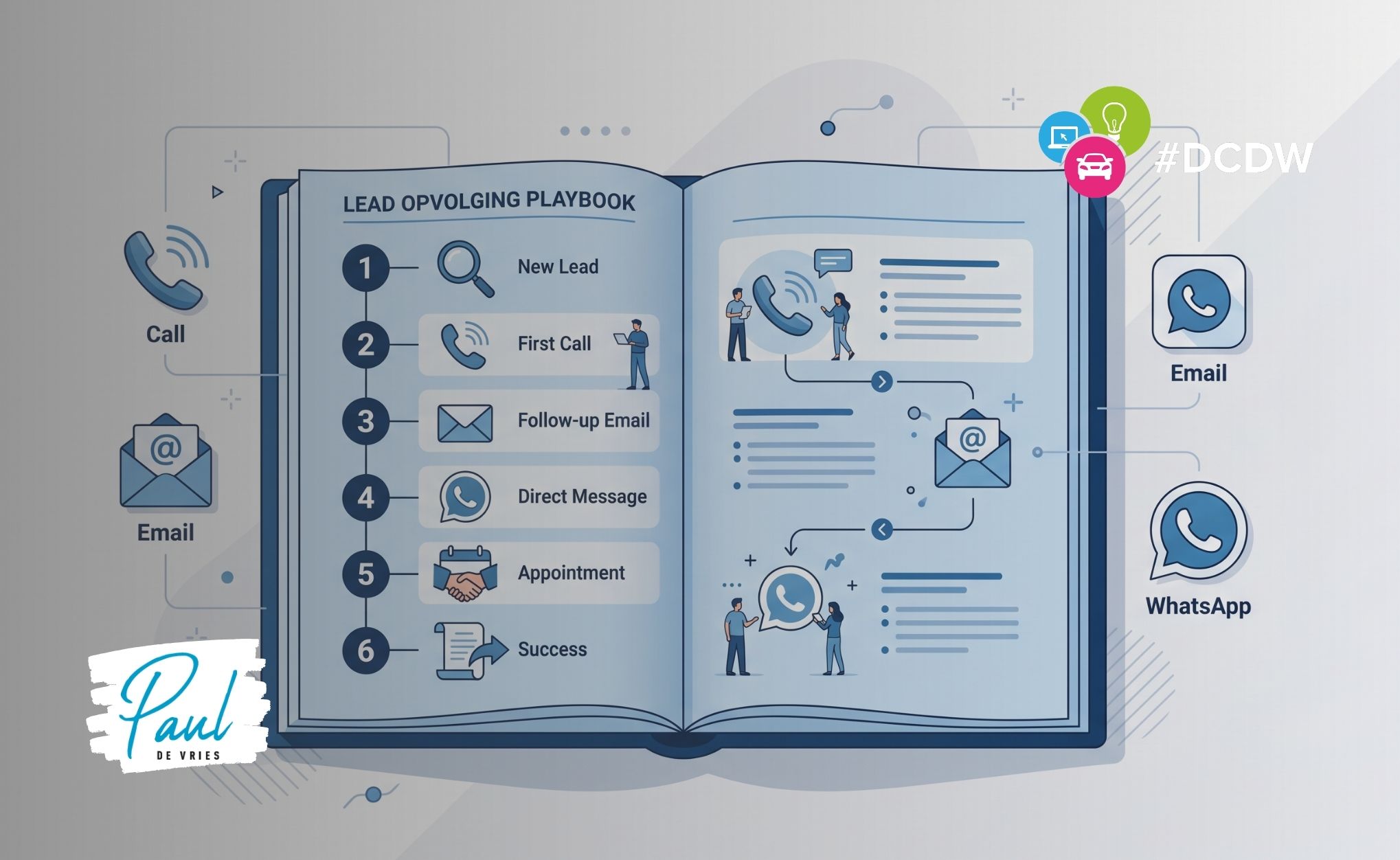
Step 1 – The North Star
The impossible goal: what is that for your organization?
Imagine that as an importer you have 20,000 leads, a response time of 60 minutes, and a lead-to-sales conversion rate of 7.2%. What then is your impossible goal? If you ask dealers to go from 60 minutes to 45 minutes and increase conversion to 8%, which yields 160 extra cars, they probably won’t change, but rather hope for a good outcome.
But if you say we are going to follow up leads within five minutes and bring the conversion rate to 13%, every dealer knows that ‘hoping’ will not bring those results. That requires a different process and a different mindset.
So, for instance, a North Star of a five-minute response time within a window of 9:00 AM to 9:00 PM ensures that every dealer starts thinking: how do I achieve that, and what process do I need for it?
When you challenge entrepreneurs, they also come up with creative ideas to reach the goals. It was solely because of this North Star that Calldrip Europe was born: lead follow-up in 30 seconds, because it is possible.
The North Star is therefore something you must determine per organization. Our clients have North Stars of seven minutes or 20 minutes, but for instance from 8:00 AM to 10:00 PM, and everything in between.
Step 2 – Lead Process Manual
Salespeople are important and most are well-trained product-wise, but not when it comes to lead follow-up. Specific online lead follow-up courses are hardly offered. Also, when you ask what process the salespeople follow, how often they call, email, or WhatsApp, it turns out that every salesperson has their own approach.
So you need a manual explaining the basics: what do you expect, and how do you want a dealer organization to handle your opportunities and your investment in marketing.
You can get this manual for free through us (just send an email to paul@dcdw.nl).
Step 3
I already mentioned it: the salesperson is the most important link, the MVP of online lead follow-up. Nobody knows more about the product, trade-ins, promotions, and everything involved than the salesperson.
It cannot be that a salesperson is ‘lesser’ than a BDC agent in lead follow-up. Both belong to the sales department. And if you just compare average salaries, you know who you pay more and who should therefore be more focused on new opportunities. The salesperson!
So if a BDC answers on behalf of the salesperson, the salesperson must read the call report, reconfirm the appointment, and take responsibility for that lead. They must not pass the buck to the Call Center.
Step 4
The MAP, the Minimum Acceptable Performance. If the North Star ideally is response time, then that is your first piece of data. But one piece of data is nothing. Response time as the sole KPI is nothing. If you call everyone within five minutes and no one answers, you still have nothing.
We now know that most salespeople have no problem selling a car to 13 out of 22 people who show up. See also the 60% rule from Part 1. So when looking at micro-conversions, making an appointment is essential.
The North Star ensures that I quickly get dialogues, and in that dialogue, making the appointment is most important. The MAP is therefore 36% appointments on leads. So out of 100 leads: 36 appointments. And if the North Star regarding response time is met, as well as that 36%, then I also know you will generate more sales.
Step 5
Inspect what you expect, meaning: if you really want to know where you stand in the game, you want to know the intermediate scores, not just the final score. The final score is the final score; the ultimate conversion is the final score.
If you want to influence the final score, you must ensure more dialogues, more appointments, and more appointments that actually show up. If you take the 60% rule as a baseline and you know how many leads were called, messaged, and emailed according to the process, and you also know how the calls went by evaluating them via Calldrip Scoring, then you know what conversion rate to expect and where you can make adjustments.
Is it down to the number of real conversations being held, or is there a need for guidance in scheduling more appointments?
Step 6
This is an extension of step 5: coaching and training. If you know where you are missing the 60% rule, you also know where to coach and train. A sales manager is primarily a coach who ensures that their salespeople sell more and make more appointments.
By listening back to conversations via Calldrip and using the coaching notes provided with each call, we can truly improve salespeople. Not with a single three-hour training session and hoping for the best.
No, just as a sponge can absorb a lot of water when you add it gradually, the same applies to training. Five minutes every day is better than sending someone to a training session once in a while.
So?
These are the six steps that are actually being applied at several importers and dealer groups in Europe. All with different North Stars, different processes, and different MAPs, but all within the same framework.
For instance, one importer went from a response time of two hours to two minutes and 30 seconds for over 40,000 leads annually. In doing so, their lead-to-sale conversion rate rose from 8.9% to 17.2%. In this setup, our CARMEN Automotive BDC served as a shell to consistently achieve the maximum five-minute response time, while the salesperson remained the most important link.
A salesperson who calls quickly using Calldrip, where possible within one minute, in a window from 9:00 AM to 9:00 PM, supported by a BDC like Carmen Automotive BDC, with the right script, right KPIs, and right coaching, can significantly increase or even double conversion.
Those who only complain about the quality of leads fail to understand that it will always be about process, process, and process once more. A so-called ‘bad’ lead in a good process has a higher chance of success than a ‘good’ lead in a bad process.
Want to know more? Let me know. I’d love to spar with you. Importer, dealer, or car company—you can make these six steps work anywhere.